Neurospace
NEUROSPACE™ | NEUROSURGERY

Plan Beyond Precision.
Predict Beyond Vision.

Neurospace brings multimodal imaging, patient-specific modeling, spatial computing, connected collaboration, and the Neurospace Intelligence Layer into one neurosurgical environment. Artificial intelligence supports synthesis, segmentation, anatomical risk analysis, predictive modeling, and trajectory intelligence—so the surgeon can see relationships, test possibilities, and anticipate consequences before the case reaches the operating room.

Human Experience + Artificial Insight · Neurospace Intelligence Layer // Neurosurgery
01 / CLINICAL CONTEXT
CONTEXT

THE CLINICAL PROBLEM

A surgical plan is only as complete as the information behind it.

Neurosurgical planning is rarely limited by a lack of data. The challenge is that the data often arrives in separate views, separate systems, and separate moments of the workflow.

Neurospace is designed to bring anatomy, pathology, function, connectivity, vascular relationships, trajectories, and clinical context into one patient-specific planning environment. Its Intelligence Layer helps synthesize those inputs into relationships the surgical team can interrogate rather than forcing the surgeon to mentally reconstruct the case across disconnected systems.

  • AI-supported multimodal synthesis across the available case data
  • Registration, segmentation, tractography, and structure delineation
  • Spatial understanding of targets, critical anatomy, and proximity
  • A planning record that can remain connected across the case
The objective is not more information. It is less fragmentation between what the surgeon knows, what the imaging shows, and what the procedure requires.
CASE CONTEXT // PT-8942 INTELLIGENCE SYNTHESIS ACTIVE
02 / PATIENT MODEL
PATIENT
MULTIMODAL MODEL // REGISTERED SEGMENTATION ASSIST // REVIEWED

PATIENT-SPECIFIC MODELING

One patient.
One spatial model.

A generic atlas can teach anatomy. Surgery requires the anatomy of the person in front of you.

Neurospace organizes the patient’s available imaging and clinically relevant structures into a common spatial environment that can be explored, measured, annotated, and used for planning. The Intelligence Layer can assist segmentation, correlate anatomy with functional and diffusion information, and prepare patient-specific structures for clinician review.

  • Patient-specific 3D representation with AI-assisted segmentation workflows
  • MRI, CT, PET, fMRI, DTI, and other available case data in context
  • Anatomical, functional, and white-matter correlation where relevant to the plan
  • Targets, structures, corridors, and annotations carried into case review
Visualization remains a means, not the endpoint. The model exists to make relationships easier to reason about before the procedure.
03 / ACTIVE PLANNING
PLANNING

ACTIVE SURGICAL PLANNING

Turn anatomy into a decision environment.

Neurospace redefines how neurosurgeons see, plan, and operate. It does not just display anatomy; it is designed to help organize the relationships that matter to the surgical decision.

Within a patient-specific case, the surgeon can evaluate candidate approaches, interrogate proximity, compare trajectories, and preserve the rationale behind the plan for collaboration and downstream workflow. The Intelligence Layer can assist by comparing spatial relationships, flagging proximity conditions for review, and supporting predictive scenario analysis without selecting the surgical plan on the surgeon’s behalf.

  • Candidate trajectory definition, comparison, and AI-assisted trajectory intelligence
  • AI-assisted risk and proximity analysis around critical structures
  • 3D spatial inspection from multiple surgical perspectives
  • Shared case review before the plan reaches the operating room
Continue the Plan
ACTIVE SESSION: PT-8942
3D MODEL LOADING...
Risk Proximity 0.2mm
Trajectory Angle 42°
04 / NEUROSPACE INTELLIGENCE LAYER
INSIGHT
NEUROSPACE INTELLIGENCE LAYER // PT-8942 SURGEON REVIEW REQUIRED
MULTIMODAL SYNTHESISREGISTERED CASE CONTEXTMRI · CT · fMRI · DTI · pathology
SEGMENTATION ASSISTANCESTRUCTURES PREPARED FOR REVIEWTarget · vessels · eloquent anatomy
ANATOMICAL CORRELATIONFUNCTION + CONNECTIVITYSpatial relationships synthesized
RISK / PROXIMITY ANALYSISCRITICAL RELATIONSHIP FLAGGEDClosest modeled relationship: 0.2 mm
TRAJECTORY INTELLIGENCE3 CORRIDORS COMPAREDAngles · paths · target relationships
PREDICTIVE MODELINGSCENARIO REVIEW ACTIVEConsequences explored, not prescribed
CASE INTELLIGENCE RELATIONSHIPS PRIORITIZED FOR CLINICAL REVIEW Final interpretation, target selection, and surgical decision remain with the responsible neurosurgeon.

NEUROSPACE INTELLIGENCE LAYER

Artificial insight built around the neurosurgical decision.

In Neurosurgery Space, AI is not a separate feature added after visualization. It operates across the case: helping synthesize multimodal data, assist segmentation, correlate anatomy with function and connectivity, analyze spatial risk, compare candidate trajectories, and support predictive surgical modeling.

The purpose is not to tell the neurosurgeon what to do. It is to expose relationships that are difficult to hold in mind simultaneously, make complexity easier to interrogate, and help the clinical team anticipate how one planning decision may affect another.

  • Multimodal synthesis across structural, functional, diffusion, and clinical case data
  • Segmentation assistance with clinician review of patient-specific structures
  • Anatomical risk and proximity analysis around targets, vessels, pathways, and critical structures
  • Trajectory intelligence comparing candidate corridors, angles, entry relationships, and target geometry
  • Predictive modeling and simulation support for exploring planning scenarios and potential consequences
  • Contextual prioritization of relevant findings and planning rationale for multidisciplinary review
Human Experience + Artificial Insight. Neurospace provides decision support. The neurosurgeon remains responsible for interpretation, strategy, and final clinical judgment.
05 / SPATIAL REHEARSAL
SPATIAL

AUGMENTED / MIXED REALITY

See the plan in the space where the procedure will happen.

Some surgical relationships are easier to understand spatially than on a flat display. Neurospace extends the patient-specific plan into Mixed Reality so anatomy, targets, trajectories, and annotations can be explored from a headset wearer’s point of view.

Pre-operative rehearsal can become a shared spatial review rather than a separate visualization exercise. The Intelligence Layer can prioritize case-relevant anatomy, trajectories, targets, and risk relationships for the surgeon to display and interrogate within the spatial view.
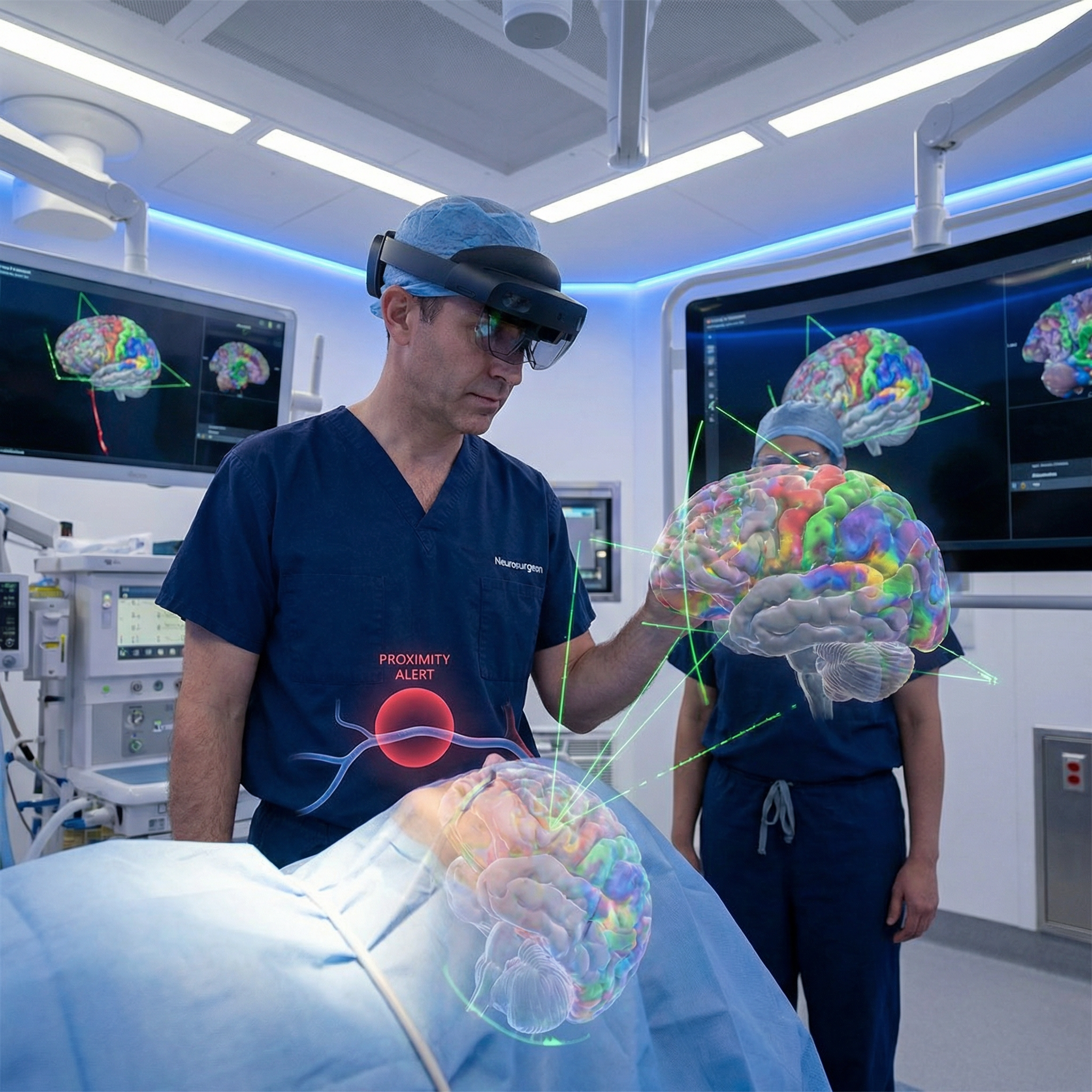
  • Headset-based spatial review of patient-specific anatomy
  • Trajectory and target visualization within an immersive planning view
  • Multi-user planning and education around the same case
  • Rehearsal, observation, annotation, recording, and replay where appropriate
Mixed Reality is functional, not decorative. Spatial overlays belong inside the headset view, where they can support the clinician without turning the operating room into science fiction.
HEADSET VIEW // MIXED REALITY SPATIAL PLAN ACTIVE
Mixed reality headset view in a clinical operating room
06 / SURGICAL CONTINUITY
CONNECT
INTEROPERABILITY // CLINICAL DATA PATH WORKFLOW LINKED
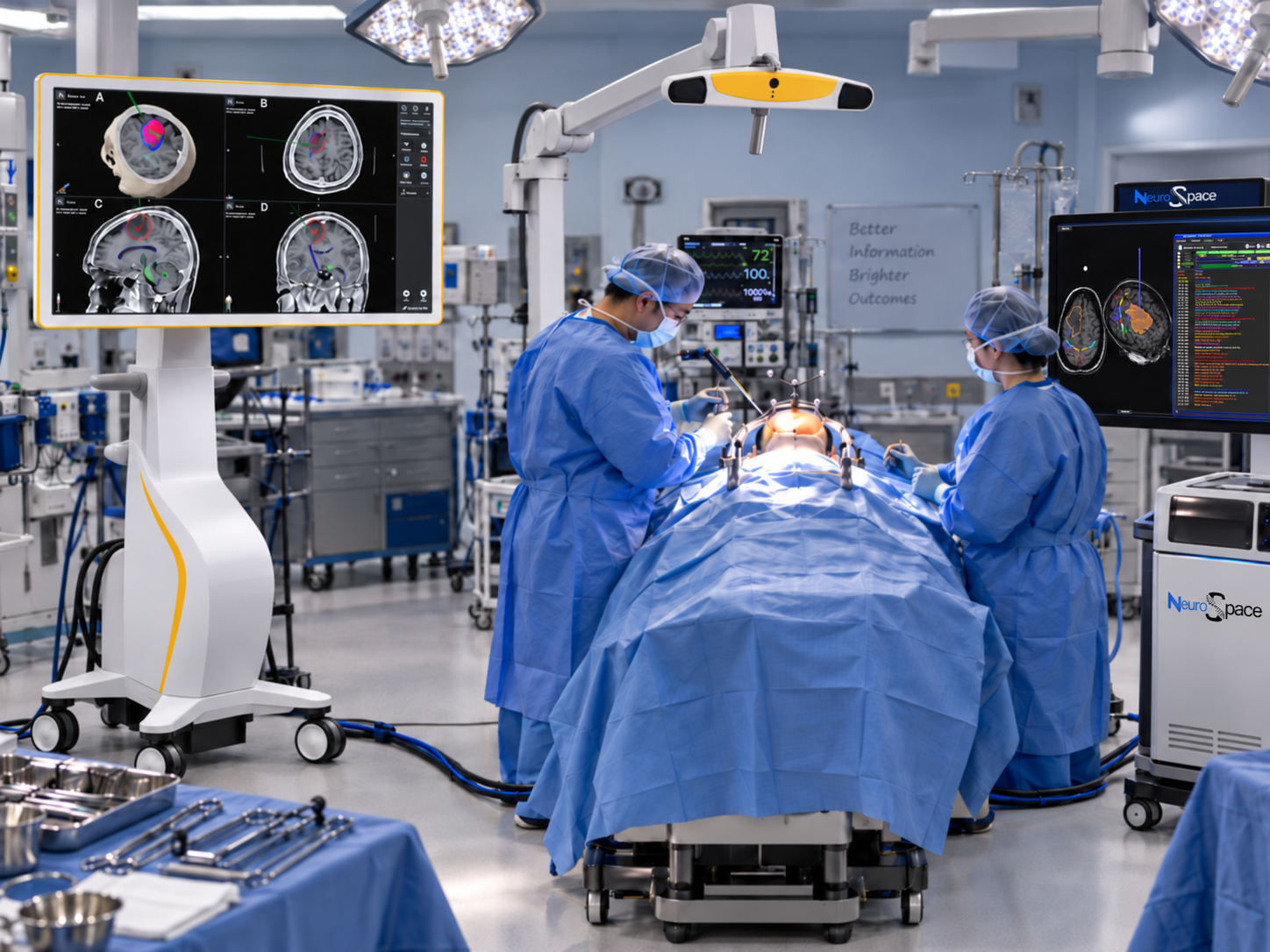
Neurospace-enabled neurosurgical operating room

INTEROPERABILITY + NEURONAVIGATION

Carry the plan forward without replacing the tools already in the OR.

Neurospace is intended to work with the clinical infrastructure hospitals already depend on. It should not require the institution to abandon PACS, DICOM workflows, neuronavigation, or established surgical technologies just to gain a more connected planning environment. The Intelligence Layer can help organize selected structures, annotations, trajectories, and case context as information moves through the workflow.

  • DICOM and PACS-oriented imaging workflow
  • Integration pathways for existing navigation and planning systems
  • Workflow intelligence supporting continuity from pre-operative planning through post-operative review
  • Controlled institutional data handling and role-based clinical access concepts
Adoption should add capability, not erase infrastructure. The platform is framed as an interoperable layer across the surgical workflow.
07 / CONNECTED EXPERTISE
EXPERTISE

NEUROSPACE TELEPORTAL

Bring expertise into the case, not just onto a call.

Complex cases often benefit from another perspective. Neurospace Teleportal extends the shared patient-specific case to remote specialists, collaborators, trainees, and partner institutions.

The goal is not another video meeting. It is shared clinical presence around the same anatomy, the same annotations, and the same surgical question. Collaborative case intelligence can help organize the relevant imaging, structures, planning context, and open questions before remote review begins.

  • AI-assisted case synthesis for remote review around a shared 3D patient model
  • Real-time spatial annotation and planning discussion
  • Multidisciplinary and cross-institutional collaboration
  • Remote observation, guidance, training, and review where appropriate
Explore Teleportal
SHARED CASE // TELEPORTAL 4 CLINICAL NODES
PRIMARY
NEUROSURGEON
REMOTE
SPECIALIST
RADIOLOGY /
IMAGING
EDUCATION /
OBSERVATION
08 / CLINICAL CONTROL
JUDGMENT
DECISION ARCHITECTURE HUMAN CONTROL ACTIVE

THE NEUROSPACE PRINCIPLE

Technology does not replace expertise. It allows expertise to see further.

Neurosurgery depends on judgment formed through training, experience, anatomy, imaging, and the realities of the individual case. Neurospace is built around that fact.

The Neurospace Intelligence Layer, spatial computing, simulation, visualization, and cloud collaboration operate as supporting layers around the clinician—not a replacement for the clinician. AI helps the team see relationships, anticipate consequences, and interrogate complexity; the responsible physician retains clinical judgment.

  • Clinical judgment remains with the responsible physician
  • Neurospace Intelligence Layer positioned as patient-specific interpretation, prediction, and planning support
  • Visual clarity designed to expose relationships, not obscure them
  • Collaboration designed to increase access to expertise
When Experience Meets Artificial Insight. That is the operating principle behind the entire Neurospace ecosystem.
NEUROSPACE™ | NEUROSURGERY

BRING THE ENTIRE CASE INTO ONE SURGICAL CONTEXT.

Request Institutional Demo Return to Homepage

Neurospace is presented here as a clinical technology platform concept. Planning, visualization, simulation, and AI functions are framed as clinician-support capabilities; clinical decisions remain the responsibility of qualified healthcare professionals.